
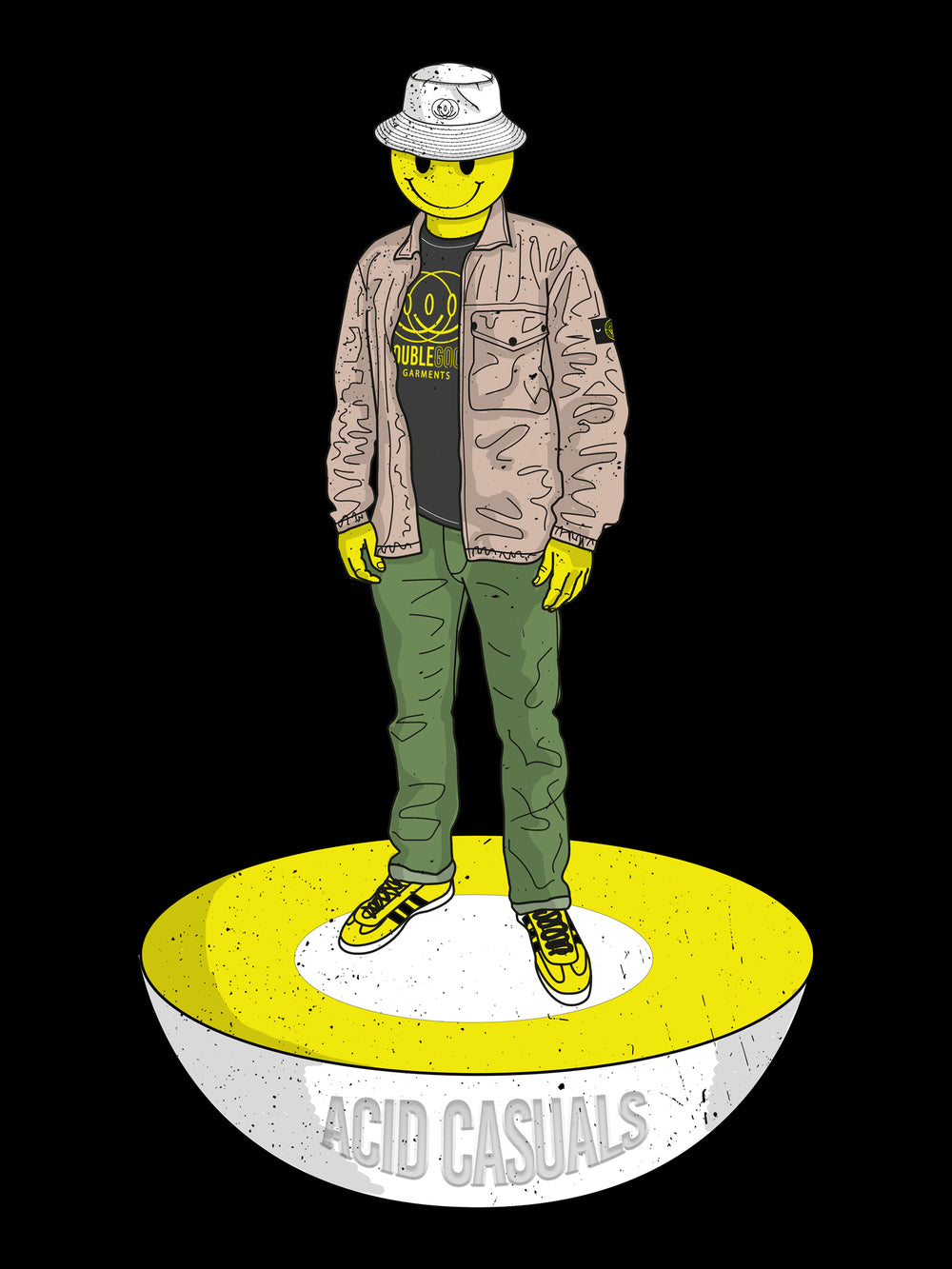
The Acid House Smiley: How a Yellow Face Became a Cultural Revolution
Few symbols have had quite the career of the acid house smiley. Originally a cheerful little yellow face designed to make people feel good, it somehow ended up at the centre of one of Britain’s biggest youth culture revolutions. Not bad for a circle with two dots and a curved line.
The smiley face itself dates back to the 1960s, when graphic designer Harvey Ball created the familiar yellow-and-black design in the United States. It was intended as a simple morale booster — a tiny piece of visual optimism that could be printed on everything from badges to posters. It was friendly, uncomplicated and, crucially, incredibly easy to draw.
By the 1970s, the smiley had become a commercial phenomenon. You could find it on clothing, stationery and just about anything else that benefited from looking aggressively cheerful. But the symbol was about to take a very different trip across the Atlantic.
In the 1980s, Britain was experiencing a cultural shift. Electronic music was developing rapidly, DJs were becoming increasingly adventurous, and young people were looking for new ways to escape the realities of everyday life. Then came house music from Chicago, techno from Detroit and, eventually, the sound that would become known as acid house.
The music was strange, hypnotic and repetitive. The Roland TB-303 bass synthesiser produced squelching, bubbling sounds that seemed to have been designed by someone who had never actually seen a normal musical instrument and wasn't particularly interested in starting now.
As acid house spread through Britain, the smiley found itself adopted as the unofficial face of the movement.
The exact story of how the smiley became so closely associated with acid house is tangled in the usual way cultural history tends to be: several people, several versions of events and enough disputed anecdotes to keep historians arguing over pints for decades. What is clear is that by the late 1980s, the yellow smiley was everywhere — on flyers, T-shirts, badges, record sleeves and club merchandise.
Its appeal was obvious. The smiley was instantly recognisable, deliberately simple and slightly mischievous. It represented fun, freedom and a sense that something was happening outside the usual rules. It also looked fantastic under nightclub lights, which is not generally a requirement for graphic design but was clearly useful in this particular line of work.
The acid house movement exploded into the mainstream in the summer of 1988, a period often remembered as the "Second Summer of Love." Illegal raves appeared in warehouses, fields and abandoned industrial spaces. Thousands of young people travelled to secret locations to dance until sunrise, often following directions that were, by modern standards, spectacularly vague.
The authorities were less enthusiastic.
As the rave scene grew, so did media attention and political concern. Newspapers portrayed the movement as a dangerous social phenomenon, while police attempted to shut down illegal events. The smiley consequently became more than a logo. It became a symbol of rebellion, collective experience and a generation determined to have a very good time despite official disapproval.
And then, inevitably, capitalism arrived.
The symbol that had represented underground culture quickly became a commercial product. The smiley appeared on mainstream fashion, advertising and merchandise, proving once again that nothing remains underground for long once someone realises it can be put on a T-shirt and sold for £25.
Yet the acid house smiley endured.
Today, it remains one of the most recognisable symbols of British rave culture. For some, it evokes memories of legendary clubs and warehouse parties. For others, it represents the birth of a new musical era that transformed dance music forever. And for an entirely different generation, it is simply a cool yellow face that looks good on clothing.
But behind the design is a bigger story: the story of how music, technology and youth culture collided in Britain and created something that changed the country's cultural landscape.
The smiley may have started life by telling people to cheer up.
By the late 1980s, it was telling Britain to dance.

Leave a comment